Hello 👋, my name is pronounced as /Yeo-un/. I also go by Rachel so feel free to call me either. I am a PhD candidate in Syracuse University iSchool. My advisor is Joshua Introne.
My research sits at the intersection of Natural Language Processing (NLP), computational social science, and responsible AI. Specifically, my focus is on whether multilingual large language models are truly multilingual, not just in performance, but in how faithfully they represent the cultural knowledge embedded in the languages they process.
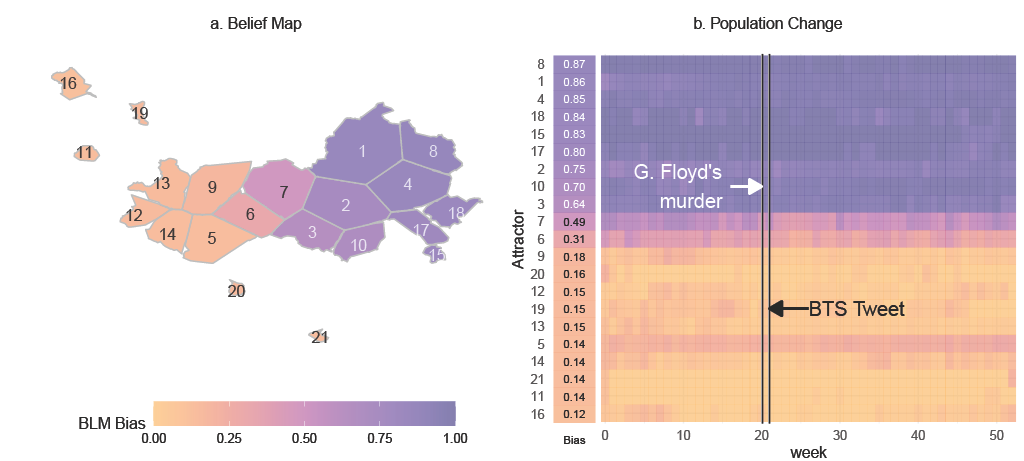
The internet has transformed activism, giving rise to more organic, diverse, and dynamic social movements that transcend geo-political boundaries. Despite extensive research on the role of social media and the internet in cross-cultural activism, the fundamental motivations driving these global movements remain poorly understood. This study examines two plausible explanations for cross-cultural activism: first, that it is driven by influential online opinion leaders, and second, that it results from individuals resonating with emergent sets of beliefs, values, and norms. We conduct a case study of the interaction between K-pop fans and the Black Lives Matter (BLM) movement on Twitter following the murder of George Floyd. Our findings provide strong evidence that belief alignment, where people resonate with common beliefs, is a primary driver of cross-cultural interactions in digital activism. We also demonstrate that while the actions of potential opinion leaders–in this case, K-pop entertainers–may amplify activism and lead to further expressions of love and admiration from fans, they do not appear to be a direct cause of activism. Finally, we report some initial evidence that the interaction between BLM and K-pop led to slight increases in their overall belief similarity.
@inproceedings{kim2026belief,title={Belief Alignment vs Opinion Leadership: Understanding Cross-linguistic Digital Activism in K-pop and BLM Communities},author={Kim, Yuheun and Introne, Joshua},booktitle={Proceedings of the International AAAI Conference on Web and Social Media},volume={20},number={1},pages={1292--1308},year={2026}}
LLM-Supported Content Analysis of Motivated Reasoning on Climate Change
Yuheun Kim, Qiaoyi Liu, and Jeff Hemsley
Proceedings of the Association for Information Science and Technology 2025
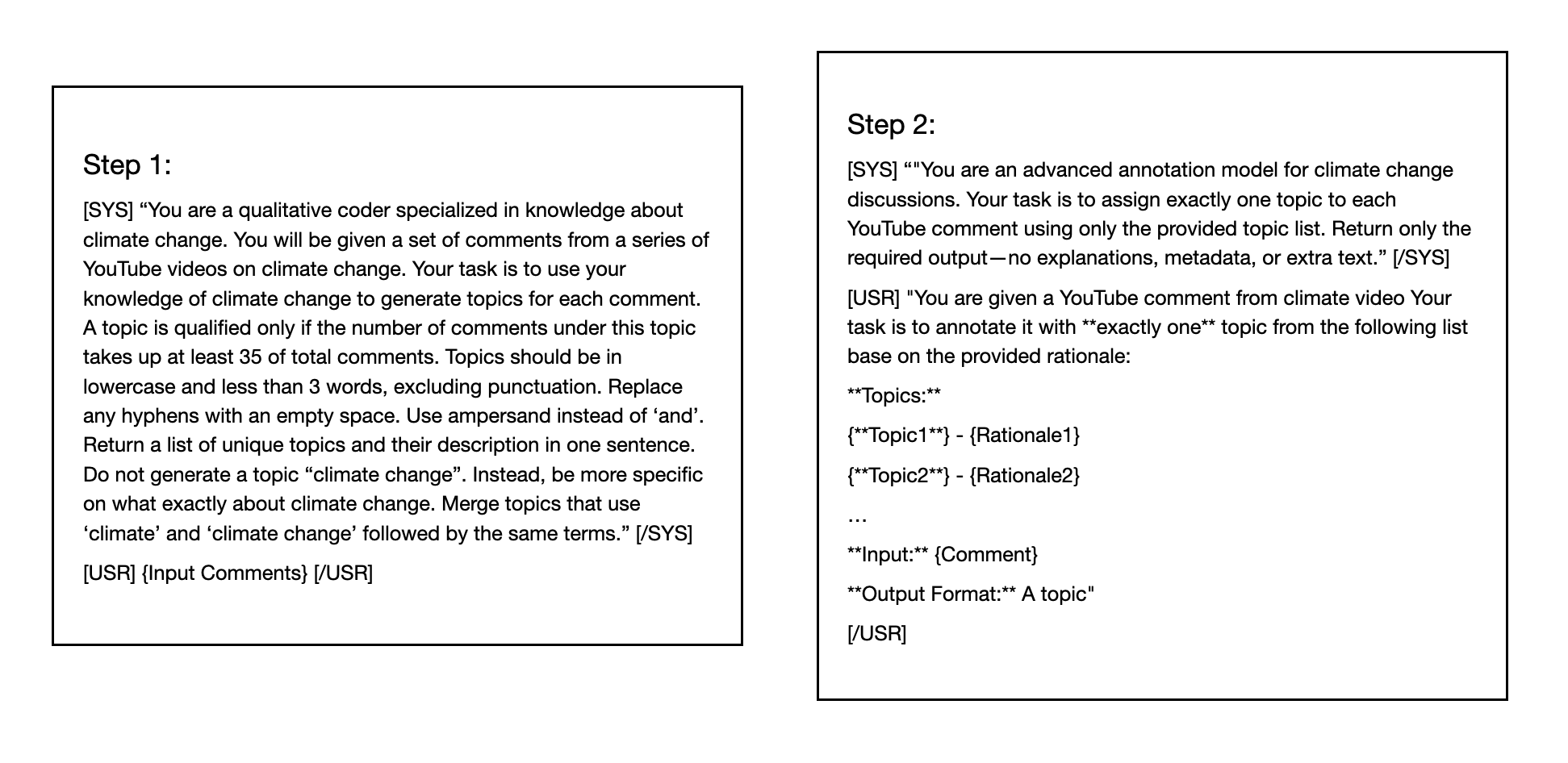
Public discourse around climate change remains polarized despite scientific consensus on anthropogenic climate change (ACC). This study examines how “believers” and “skeptics” of ACC differ in their YouTube comment discourse. We analyzed 44,989 comments from 30 videos using a large language model (LLM) as a qualitative annotator, identifying ten distinct topics. These annotations were combined with social network analysis to examine engagement patterns. A linear mixed-effects model showed that comments about government policy and natural cycles generated significantly lower interaction compared to misinformation, suggesting these topics are ideologically settled points within communities. These patterns reflect motivated reasoning, where users selectively engage with content that aligns with their identity and beliefs. Our findings highlight the utility of LLMs for large-scale qualitative analysis and highlight how climate discourse is shaped not only by content, but by underlying cognitive and ideological motivations.
@article{kim2025llm,title={LLM-Supported Content Analysis of Motivated Reasoning on Climate Change},author={Kim, Yuheun and Liu, Qiaoyi and Hemsley, Jeff},journal={Proceedings of the Association for Information Science and Technology},volume={62},number={1},pages={347--357},year={2025},publisher={Wiley Online Library}}
Can ChatGPT Understand Causal Language in Science Claims?
Yuheun Kim, Lu Guo, Bei Yu, and Yingya Li
In Proceedings of the 13th Workshop on Computational Approaches to Subjectivity, Sentiment, & Social Media Analysis Jul 2023
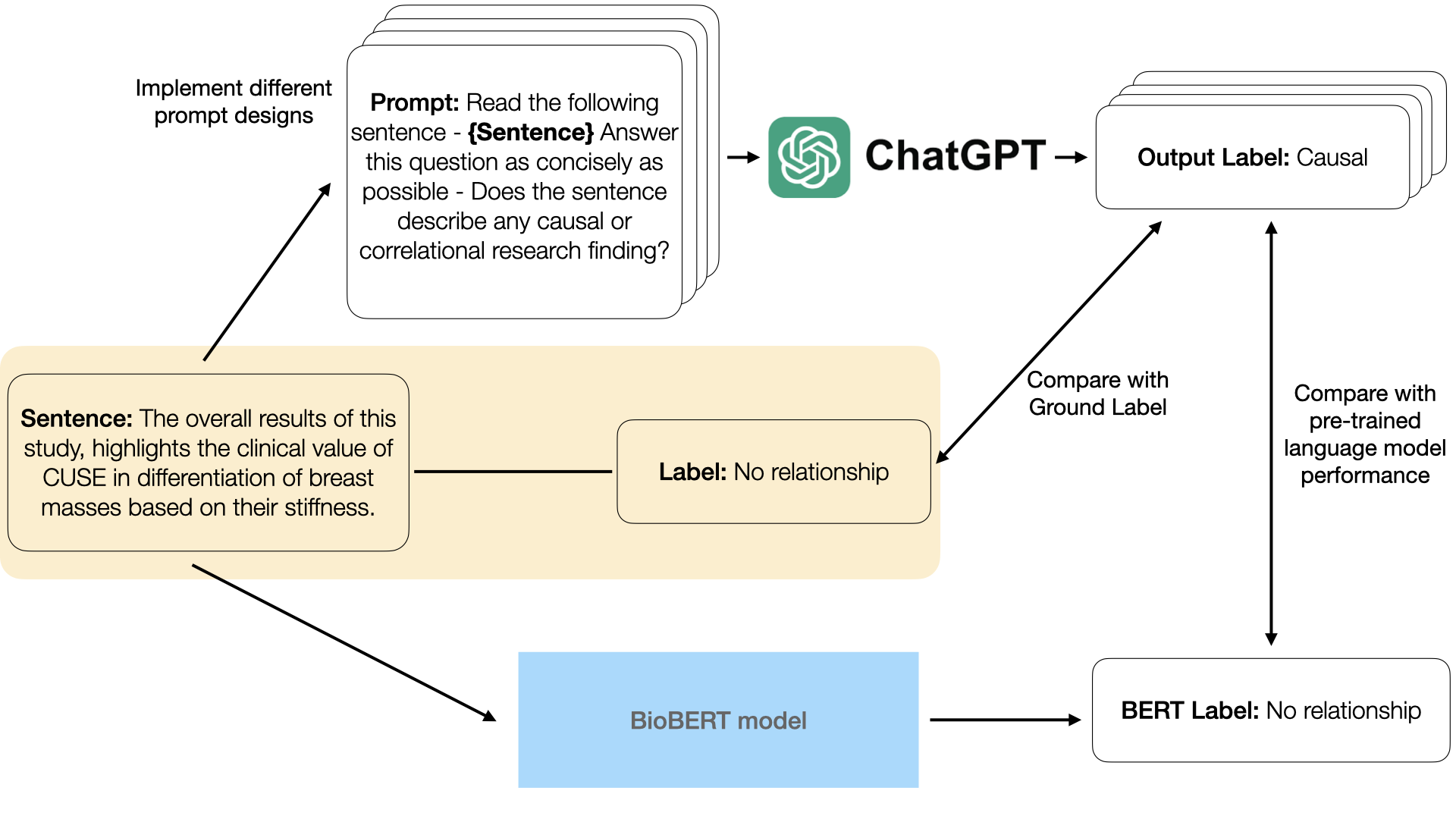
This study evaluated ChatGPT’s ability to understand causal language in science papers and news by testing its accuracy in a task of labeling the strength of a claim as causal, conditional causal, correlational, or no relationship. The results show that ChatGPT is still behind the existing fine-tuned BERT models by a large margin. ChatGPT also had difficulty understanding conditional causal claims mitigated by hedges. However, its weakness may be utilized to improve the clarity of human annotation guideline. Chain-of-Thoughts were faithful and helpful for improving prompt performance, but finding the optimal prompt is difficult with inconsistent results and the lack of effective method to establish cause-effect between prompts and outcomes, suggesting caution when generalizing prompt engineering results across tasks or models.
@inproceedings{2023-kim-chatgpt,title={Can {C}hat{GPT} Understand Causal Language in Science Claims?},author={Kim, Yuheun and Guo, Lu and Yu, Bei and Li, Yingya},booktitle={Proceedings of the 13th Workshop on Computational Approaches to Subjectivity, Sentiment, {\&} Social Media Analysis},month=jul,year={2023},address={Toronto, Canada},publisher={Association for Computational Linguistics},pages={379--389}}